


2025 Reading Recap: Preparing for Change
What can I say about 2025 that everyone else hasn’t already said? I’ve seen countless Instagram carousel posts on my feed of stunning scenery, culinary delights, warm moments with family and friends for each month that look positively dreamy. Then, I snap open my Saturday newspaper, where I’m sent into a blank stare of existential dread of what could be ahead on the global stage in 2026. I go online, looking for another dopamine surge, and seek out some balance: people acknowledging challenges and achievements.
This year, I’m even more committed to learning about the changes to global media and what could be coming around the bend. What will be the effect of AI on social media as well as traditional media? Are we tired of talking about AI yet, and we’ll lean into our creativity and imperfections to counterbalance this technology? I’m aware that I need my critical thinking cap on for everything I read. I’m asking, “What is being said? What isn’t being said? Why did they choose that particular word?”
I find it difficult to balance open-mindedness and critical thinking while reading, both online and in books. Sometimes, looking deeper is fun and stimulating. Other times, it’s tiring because I also read for relaxation. But it’s this practice of gathering information and other perspectives, refracting through my own experience and looking for commonalities and differences, that is where I have the best chance of sense-making.
History being Helpful
Overall, I’m thankful for the foundation of my history degree, as it feels like history is looping around and we’re seeing present-day versions of challenges that humanity has seen before. What I’ve learned as a student of history is that we’ve been at flashpoints of change before, and it will certainly happen again. We are facing multiple challenges at scale right now; challenges like combating climate change will require innovative thinking, but there is wisdom in history from other eras that have witnessed and overcome environmental challenges. And upholding democracy for the future needs our attention once again.
I’m asking myself what I can do; I have more experience than I did when I was younger, and I have energy to take action. I want to see the world progress and eliminate challenges so we can all live in peace, health, and prosperity. There is so much impressive knowledge out there, from past and present thinkers, artists, and writers. I hope to soak up as much of that as I can for hope and actionable wisdom.
Reading Goals Review
All that to say, my reading vibes for 2026 are:
- Combatting Climate Change and transitioning to green energy
- Media, ethics, and democracy (again)
- Civic engagement, resistance, and resilience.
- History of countries I hope to visit, as well as past environmental challenges.
- Literary translations – I’m yearning to experience “culture shock” in 2026, and I think the ideas shared from writers in other cultures, not close to North America, will get me there.
My reading life in 2025 was focused on:
- Reimagined Futures
- Science & Technology
- Media, ethics, and information systems
- Democracy and civic involvement
- Translations
As I perused the book titles, I managed to read at least one book on each of these topics. My most-read was science fiction with themes of reimagined futures and science & technology. I leaned heavily on Ursula K. Le Guin’s wisdom and read 4 of her works in 2025.
Diversity Report
This year, I read quite similarly to last year in terms of diversity. Many of my titles covered multiple regions or topics, which I feel reflects our interconnected world.
- North America – 17
- Russia & Central Asia – 1
- Europe – 10
- South & Central America – 1
- Middle East & North Africa – 1
- Sub-Saharan Africa – 0
- East Africa – 0
- East Asia – 1
- South Asia – 0
- Southeast Asia & Australia – 2
- Indigenous Peoples – 2
- 2SLGTBQI+ – 2
- Equity-denied Peoples – 10
- Environmental Issues – 2
- Space – 3
I’m embarrassed that I have again not read any works from Africa, which would undoubtedly provide the cultural learnings that I want in 2026. North American publishing does not make it easy to discover authors from African countries. However, there are publishers who are undertaking translation projects, and I’m pleased to see this article about African author translations in The Conversation from August 2025.
What Did I Learn
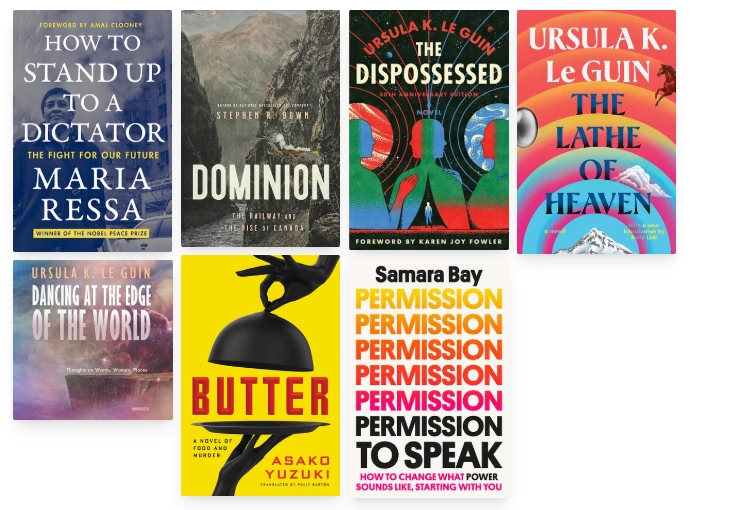
Well, four Ursula K. Le Guin books probably have more knowledge in them than I’ve gained in my lifetime. I have always held on to the idea that the books you read 5 years ago inform who you are today. It’s going to take me a while to grasp everything she shared in “Dancing at the Edge of the World: Thoughts on Words, Women, Places” – but it was so, so wonderful.
My favourite essays were:
- The Fisherwoman’s Daughter
- Where Do You Get Your Ideas From?
- The Carrier Bag Theory of Fiction
I learned a lot about the politics and systems in Silicon Valley and the tech world from Cory Doctorow. I read a couple of the books in his “Martin Hench novels” series. Both were fast-paced, and I learned a ton about cryptocurrency and the history of Silicon Valley’s beginnings. A fun way to learn, as these novels are financial crime mysteries. I recommend the podcast series he did with CBC’s Understood. In Canada, we are at a point where we should be protecting ourselves with our own digital laws. Check out his podcast and then consider writing to your MP about what you think our nation should do to protect our digital sovereignty.
CBC’s Understood – Season 5 – Who Broke the Internet? The internet sucks now, and it happened on purpose.
CBC’s Understood – Season 1 – The Naked Emperor: the rise and fall of bitcoin king Sam Bankman-Fried. (this is also really good if you are curious about the origins of crypto)
I read a lot about resistance against injustice and abusive power – both in this world and science-fictional ones. I re-read Timothy Snyder’s “On Tyranny”; there is an incredible graphic novel version he did with Nora Krug that I can’t recommend enough. Ursula K. Le Guin has a lot to say about resistance and the abuse of power in her work. This year, I read “The Dispossessed” and “Five Ways to Forgiveness.”
One topic I did not expect to delve into further was dreams. First, I read the “Lathe of Heaven” by Le Guin – a book about a man whose dreams can change reality. We learn that the desire to change the world for the better can have unintended consequences. For Christmas, I was given “An Alphabet for Dreamers: How to see the world with eyes closed” by Sharon Sliwinski. I intend to journal my dreams in 2026 and see what happens – perhaps, I will see some wisdom in my subconscious.
I also read “Is a River Alive” by Robert MacFarlane. I love his writing, and I’m obsessed with rivers, so this was a must-read. This non-fiction account was a global journey of how different nations have treated their rivers and how they are moving forward after much damage from extraction and disregard for the river’s life force. In Quebec, the Innu Council of Ekuanitshit and the regional municipality of Minganie passed resolutions to give personhood to the Muteshekau-shipu (Magpie) River and set a new legal precedent. This protects the river’s right to flow and be free from pollution. Wouldn’t that be a dream to declare personhood to our great rivers in Alberta – the North Saskatchewan, the Bow, and the Oldman River?
The book I’ve recommended the most is “How to Stand Up to a Dictator” by Maria Ressa. This book is absolutely incredible in its analysis of social media, how it can be manipulated, and how it can take down a democracy. It shares how political autocrats use bots and online techniques to flood the system with disinformation to make it feel like there is popular support. There are so many vital lessons from this book and what happened in the Philippines for those of us in North America.
“What happened in the Philippines in 2016 is a microcosm of every information operation launched in democratic countries around the world. The combination of bots, fake accounts, and content creators (real people like Mocha Uson) infected real people like a virus…”
“This is how information operations work everywhere. Lies that are repeated over and over exponentially change the public’s perception of an issue, something that world powers have always known about propaganda but that gained new mean and pitch in the age of social media.” – Maria Ressa, How to Stand Up to a Dictator
Ressa is a genius, and this book is a gift to the world. I’m so pleased that she was awarded the novel Peace Prize in 2021.
About Me

Recent Posts
- 2025 Reading Recap: Preparing for Change January 4, 2026
- My Best Books of 2024 and Leaving GoodReads January 3, 2025
- Creating PLAYFUL BEINGS Tarot Deck – a peek behind the scenes February 29, 2024
- Intaglio Printmaking – A Great Medium for Nature Art February 6, 2024
Leave a Reply